Winnemem War Dance at Shasta Dam
by Toby McLeod – June 18, 2026
Donald Trump’s Big Bad Bill (2025) allocated $40 million to revive a plan to increase the height of Shasta Dam, a terrible idea that was killed years ago in part because it would flood dozens of Winnemem Wintu sacred sites. Adding 18 feet to the 602-foot-high concrete behemoth has long been a dream the California water mafia, which year after year channels liquid gold across hundreds of parched miles, grows food for the world on desert land far to the south of Shasta Reservoir, and profits mightily. As the dam raise plan developed momentum two decades ago under George W. Bush, the opposition grew fierce, and the Winnemem took resistance to another level.
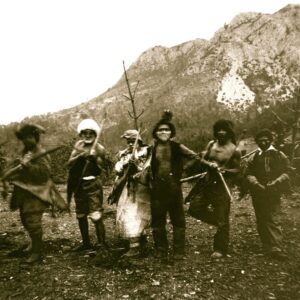
War Dance in 1887
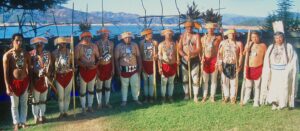
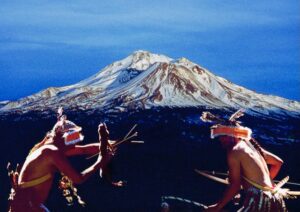
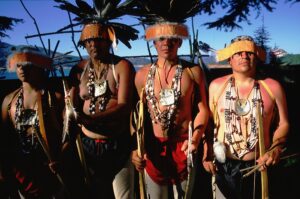
From September 12 to 16, 2004, the Winnemem performed a War Dance next to Shasta Dam in northern California, within view of their sacred Buliyum Puyuuk (Great Mountain), Mt. Shasta. It was the first war dance since the late 1880s, when the Winnemem confronted biologist Livingston Stone as he started building a salmon hatchery in their ancestral homeland along the banks of the McCloud River. Stone and the Winnemem eventually came to an understanding and the hatchery provided jobs for the Winnemem—and some protection from Gold Rush era genocide. An historic photo shows how seriously native people take threats to their homeland.
Raising the dam today would add insult to injury. When Shasta Dam was completed in the 1940s, Winnemem villages, burials and sacred sites were flooded and lost forever. Salmon could no longer reach their spawning grounds in the cold water that flows off Mt. Shasta. It was a cultural and ecological disaster. But the dam engineers always wanted to go higher, and by 2004 the U.S. government was proposing to raise the height of the dam by 18 to 200 feet. The Winnemem mounted an effective opposition campaign and our documentary films were part of the resistance.
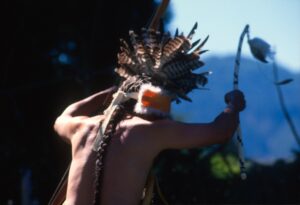
As the dam raise proposal gained momentum, Winnemem Dance Captain Rick Wilson received a message in a dream—it was time to perform Hu’p Chonas—a War Dance—in response to the government’s plans to enlarge a giant reservoir that threatened to flood dozens of remaining sacred cultural sites, such as Puberty Rock, where young girls have been initiated for generations.
For four days and nights a dozen men fasted and danced around the sacred fire as Winnemem women sang to give the warriors strength. This was spiritual resistance to political malfeasance. The Winnemem were making a statement—We are willing to die to defend our homeland. The War Dance represented a coming together of the tribe, which was seeking strength and unity in the face of adversity.
 I was part of the Media Committee and we filmed day and night through the War Dance ceremony. We brought 30 tapes and filled them all, shooting 15 hours over the four days. The inspiring story reached around the world via the brand new World Wide Web, with surprising consequences.
On day one, Winnemem Chief Caleen Sisk held a press conference, with the dam behind her. “Our salmon stop right here,” she said, “they’ve never come home again. This dance is for them, a prayer to bring the salmon home. We are here to tell the river, to tell the salmon, to tell the world: we are still here. We’re going to ask the waters—and all the relatives—to help us protect our sacred sites.”
The celebrity, tree-sitting forest protector Julia Butterfly Hill spoke, and you could feel the value of a charismatic activist supporting the Winnemem and attracting media attention. As a young Winnemem man nestled a wooden drum into the soil and tuned the drum’s sound, New York Times reporter Dean Murphy stood watching, taking notes. I wondered what he was seeing, what the lighting of the sacred fire meant to him, what our scruffy film crew looked like to a seasoned New York journalist. There was a lot of discussion about cameras and photographers. The dancers were worried they would be distracted and their prayers weakened—but Caleen told the men cameras were necessary to get the story out. She had made up her mind.
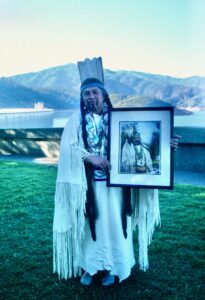
Winnemem Chief Caleen Sisk with photo of top doctor Florence Jones (1907-2003)
I helped schedule a New York Times interview with Caleen for 10am on the first morning of the ceremony. At 10:20 Caleen was sitting in the shade writing something down. I interrupted her and she waved me off and said, “There’s a song coming in.” She asked me to find a tape recorder, into which she sang the new song. Then she got up and went for the interview with Dean Murphy. The photographer for the Times, Peter DaSilva, approached me and asked about setting up a remote controlled camera inside the arbor near the fire to get a close-up shot of the dancers. Dance Captain Rick objected at first, but then deferred to the chief and said “It’s an East Coast paper, so okay.” Caleen instructed me to place the camera and retrieve it at the end of the day. DaSilva showed me how he could link the camera to a satellite and send the photo to New York with the press of a button. (This was 2004, and we were in a remote location, so this seemed like magic to me.) The story ran the next day in the New York Times, with a photo of Rick (see below).
Next morning, our film crew drove all over Redding trying to find a newspaper. We finally found one at Barnes and Noble. We took it back to the camp at the dam. Everyone was bundled up in blankets after a cold night. They asked me to read the story to them. Everyone was in good spirits as they bombarded me with instructions. “We don’t have our glasses.” “We can’t read.” “Read it in Wintu.” “For English, press one.” As I started to read the long, excellent article, the feeling was thrilling. When I got to the line describing Gary Mulcahy’s T-shirt—“depicting armed Indians and bearing the inscription ‘Homeland Security: Fighting Terrorism Since 1492.’”—Gary cried a war whoop and gave me a high five. After I finished reading, Dave Martinez said, “When you read that it lifts our spirits up so high.” One of the singers said, “The government is more worried about TV images than they are about our prayers.”
 I walked with Gary over to the wall above the reservoir. He said, “If this doesn’t work we’ll have to do the Ghost Dance.” As I felt the weight of that comment, I took a deep breath and felt my gaze pulled to the right, over the water. A bald eagle, white head, white tail, coasted by at eye level about 40 feet away, soaring along the edge of the “lake,” directly in front of Mt. Shasta. I yelled “bald eagle” and watched the majestic bird glide by, tilt its head and look back into the arbor, at the fire. I had a clear, unforgettable look into its golden eye, at its sharp yellow beak. I ran to tell Caleen, who smiled knowingly. Later, she came over to say that when Gary and I saw the eagle, the women were singing the song that had come in to her the previous morning, which asks eagle and osprey to carry the Winnemem prayers to the Creator.
Senator Dianne Feinstein did not appreciate the War Dance. In a remarkable non-coincidence, as the ceremony got underway, after ten years of waffling, the U.S. Senate approved $184 million in funding for a feasibility study on raising Shasta Dam. We also received word that a bill sponsored by Senator Ben Nighthorse Campbell, which would have granted federal recognition to the Winnemem Wintu Tribe, had been killed in committee.
 But there was also good news. A few weeks after the War Dance, Caleen Sisk receive a phone call from a professor in New Zealand, who said, “We have your salmon.” Unbeknownst to the Winnemem, Livingston Stone had exported fertile salmon eggs from the McCloud River all over the world in the early 1900s, and the only river they survived in—thrived in—was the Rakia River on the South Island of New Zealand. It was the War Dance, the internet, the songs, the prayers, the New York Times plus a dozen other reports, that a century later has led to the opportunity to bring wild salmon home to the Winnemem—the middle water—the McCloud River. As we continue to fight Trump’s renewed proposal to raise that damn dam, please join the resistance, and stay tuned.
Check out the September 14, 2004 New York Times article: “At War Against Dam, Tribe Turns to Old Ways” by Dean Murphy.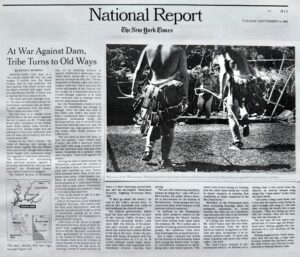
Click to watch our 8-minute film “Winnemem War Dance at Shasta Dam—September 12-16, 2004”